
Zero Click Marketing Strategy: How to Build Brand Influence When Platforms Block Traffic

Building your customer acquisition pipeline around outbound website clicks is a structural trap. Executing a successful zero click marketing strategy requires accepting a hard operational truth: ad networks, social channels, and search engines are built to keep users on their own properties. If your revenue model depends on pulling cheap traffic off third-party feeds and onto your landing page, your acquisition costs will compound until your margins disappear.
The Mechanical Reality of Platform Retention
Ad networks and search engines profit from user attention. Every time an outbound link directs a user away from a social feed or search engine, that platform loses impressions and ad inventory. Over the past decade, platform engineers have systematically redesigned algorithms to punish link-heavy updates and retain attention on-site.
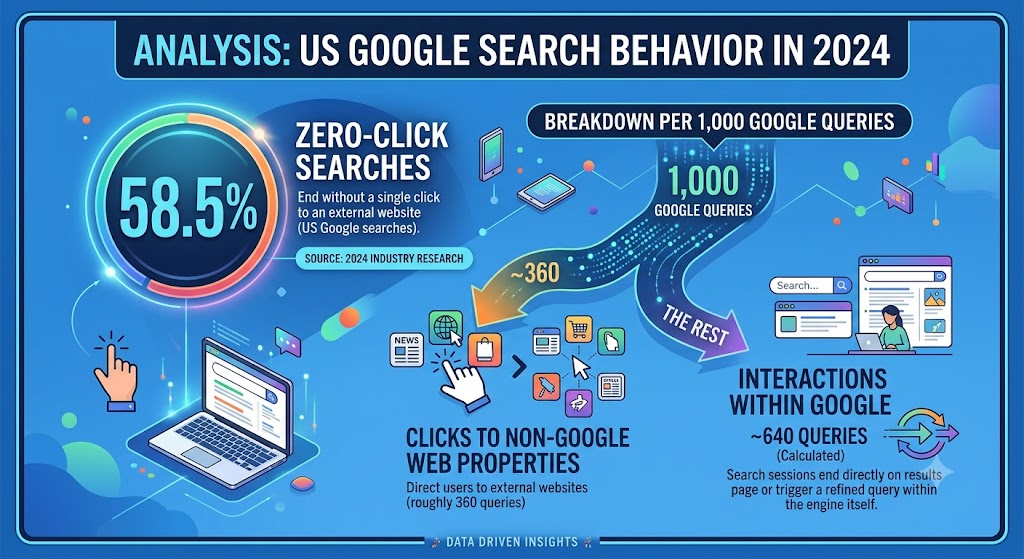
Industry research from 2024 shows that 58.5% of US Google searches end without a single click to an external website. Out of every 1,000 Google queries in the US, roughly 360 result in clicks that direct users to non-Google web properties. The rest of those search sessions end directly on the results page or trigger a refined query within the engine itself.
The pattern is even more aggressive across social networks. Internal reporting from Meta indicates that 97.3% of US Facebook post views occur on updates containing zero outbound links. Across major platforms, posts published without external URLs generate approximately ten times the reach of updates that include outbound links. When you attach a destination link to a social post, the algorithm penalizes its distribution immediately.
At the same time, search behavior is dispersing across multiple interfaces. While traditional search engines still process roughly 81% of global query volume, e-commerce platforms now handle 10%, social platforms account for 5%, and AI tools manage 3%. Global web traffic is heavily consolidated at the top, with Google alone generating web traffic comparable to the next 13 largest websites combined. Winning visibility requires delivering complete answers directly inside the feeds where your prospects spend their time.
Why Traditional Analytics Dashboards Are Lying to You
Most business owners monitor web analytics dashboards that track linear click-through paths. These dashboards paint a false picture of how buyers actually make decisions. Measuring success strictly through web traffic creates blind spots that cause operators to cut off high-performing awareness channels.
Technical tracking barriers have crippled traditional web analytics. Average browser cookie rejection rates hover near 70%, ad-blocker usage ranges between 20% and 60%, and cross-device buying journeys break simple tracking cookies. Furthermore, dark social channels such as private messaging apps, internal team chat groups, and secondary platforms hide genuine referral sources. Standard analytics packages regularly misclassify dark social leads as generic direct traffic.
This tracking gap leads to severe capital misallocation. Controlled blackout ad testing demonstrates that standard multi-touch attribution models can overestimate actual incremental return on ad spend by two to ten times. Marketers who evaluate performance solely on immediate last-click data end up over-investing in bottom-of-funnel capture tools while starving the channels that actually create demand.
Your total website traffic can decline significantly without decreasing underlying company revenue. Rather than obsessing over raw visitor counts, operators must build an ROI tracking framework based on overall audience reach, qualitative buyer self-attribution, and cash-in-bank revenue. If you want to evaluate real performance, focus on building an ROI system focused on revenue instead of clicks.
Building Infrastructure for In-Feed Distribution
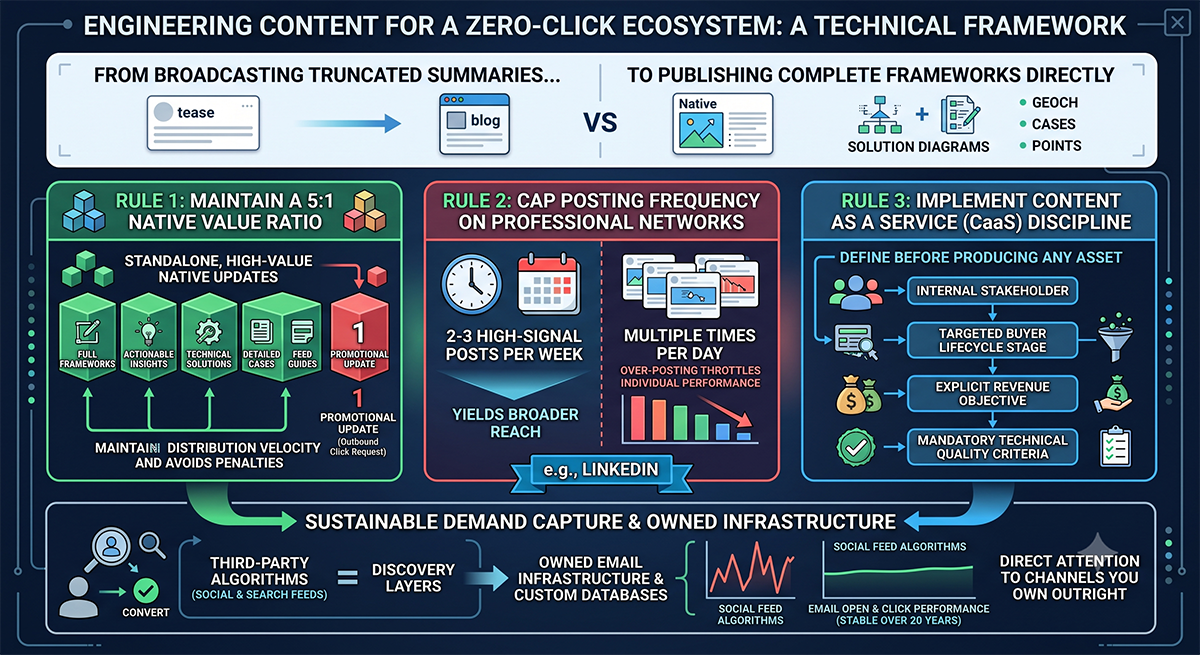
Adapting to a zero-click ecosystem does not mean abandoning content creation. It means engineering content assets that deliver full technical value inside the feed without requiring an immediate click. To maintain distribution velocity without triggering platform penalties, structure your publishing workflow around three technical rules:
-
Maintain a 5:1 native value ratio: Publish roughly five standalone, high-value native updates for every single promotional update that requests an outbound click.
-
Cap posting frequency on professional networks: On business platforms like LinkedIn, publishing two to three high-signal posts per week yields broader reach than posting multiple times per day. Over-posting within a 24-hour window throttles individual update performance.
-
Implement Content as a Service (CaaS) discipline: Before producing any asset, define its specific internal stakeholder, targeted buyer lifecycle stage, explicit revenue objective, and mandatory technical quality criteria.
Instead of broadcasting truncated summaries that tease a blog post, publish the complete framework directly into the post body. Give away the core solution upfront. When potential clients consume detailed, actionable insights directly in their feed, your technical authority grows. The small fraction of prospects who need custom engineering will seek out your site directly when they are ready to hire you.
To capture that demand sustainably, direct user attention toward channels you own outright. Third-party algorithms can adjust their reach parameters overnight, but email infrastructure remains stable. Industry tracking over a twenty-year period confirms that email open and click performance has stayed remarkably consistent compared to volatile social feed algorithms. Treat social and search feeds as discovery layers designed to feed your owned email infrastructure and custom databases.
Defending Brand Authority in AI and Discussion Networks
Search engines are evolving into answer engines. Large language models synthesize web data to deliver answers directly inside search results. Understanding how visibility shifts toward answer engine optimization is critical for preserving your brand’s presence in automated summaries.
Generative AI tools collect context from public discussion boards, independent media outlets, and online forums. On unbranded technical search queries, public discussion platforms like Reddit frequently outrank official software vendors. If your target market is discussing your industry solutions on public boards, generative AI engines scrape those conversations and integrate them into automated summaries.
Unaddressed negative commentary or outdated product details on community boards can contaminate automated AI results. Modern brand management requires actively monitoring public forums, contributing technical answers in public communities, and ensuring third-party media outlets carry accurate technical specifications regarding your services.
Rather than battling algorithm shifts by chasing short-lived platform trends, focus on establishing permanent technical footprint assets. When Google displays AI Overviews, your brand should be cited as the primary underlying source. You can read more about how AI overviews absorb search traffic without sending visits to adjust your content structure accordingly.
Shift Your Metrics From Clicks to Cash Flow
The era of buying cheap traffic and relying on simple conversion funnels is over. Search engines and social platforms will continue tightening link suppression to keep user attention on their own sites. Companies that insist on hiding value behind link gateways will see their reach decline and acquisition costs escalate.
Winning in a zero-click environment requires a fundamental realignment of your marketing metrics. Stop evaluating content performance by surface-level click-through rates. Start measuring correlational growth across total target audience reach, direct inbound inquiries, sales pipeline velocity, and bottom-line profit.
Engineered marketing systems treat native content as a trust generator, owned email networks as a conversion environment, and clean custom code as the foundation that ties everything together. When you deliver undeniable expertise directly inside the feeds where your clients live, you build brand dominance that third-party algorithm updates cannot strip away.
“The pie is getting bigger, but the slice that reaches your website is getting smaller.”
— the source
